
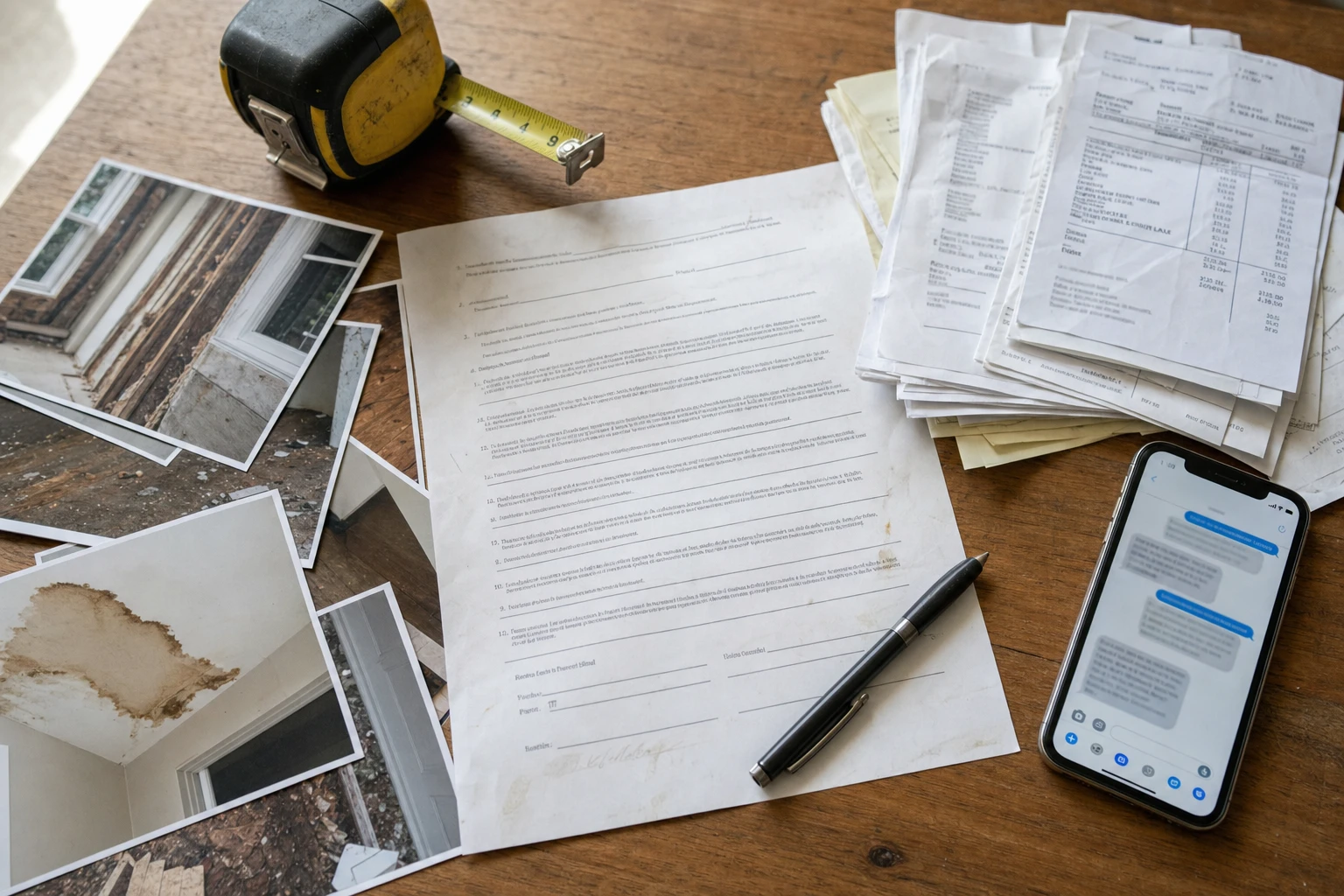
Do I have a case against my contractor? It is the question Ontario property owners ask most often once a renovation goes wrong, and the answer turns on far more than whether the finished work looks unattractive. Construction and renovation projects rarely proceed without minor imperfections. Painting may require a second coat, trim may need adjustment, or a cabinet door may need realignment after installation. These ordinary issues are part of many projects and are usually resolved quickly.
More serious problems are different. Floors begin to separate within weeks. Roofs leak after the first rainfall. Tiles crack because they were installed improperly. Decks become unstable. Concrete deteriorates far sooner than expected. Water enters through windows that were recently replaced. Electrical fixtures fail. Plumbing leaks damage newly renovated rooms.
When these kinds of problems arise, property owners often ask the same question: do I have a legal claim?
The answer depends on much more than whether the work looks unattractive or whether the contractor insists the project was completed properly. Understanding how defective workmanship is evaluated can help property owners decide whether a dispute may justify legal action and, just as importantly, whether litigation is likely to succeed.
What Is Defective Workmanship?
Many people assume defective workmanship means work that violates a building code or fails a municipal inspection. That is only part of the picture. Work can satisfy minimum regulatory requirements and still be legally deficient if it fails to deliver what was reasonably promised or expected.
When someone hires a contractor, they are usually purchasing more than labour. They are relying upon the contractor’s knowledge, experience, judgment and skill. Whether the agreement concerns installing flooring, building a deck, replacing a roof, renovating a kitchen or completing commercial construction, the contractor is generally expected to perform the work competently and produce a finished product that is reasonably suitable for its intended purpose.
The issue is not whether absolute perfection was achieved. The issue is whether the work meets the standard that a reasonably competent contractor performing similar work would ordinarily achieve.
A Project Does Not Have to Be Perfect
This surprises many property owners. Construction is not manufacturing. Natural materials vary. Existing structures may be imperfect. Older homes often conceal problems that become visible only after demolition begins. The law generally recognizes these practical realities.
Minor cosmetic imperfections do not automatically create legal liability. Slight paint touch-ups, a minor adjustment to cabinet hardware, or replacing a damaged trim piece may simply form part of the normal completion process. The existence of small deficiencies does not necessarily mean the contractor breached the agreement.
Conversely, repeated mistakes, poor planning, unsafe construction, inferior installation methods or workmanship that fails shortly after completion may indicate something far more serious. Each situation must be evaluated according to its own facts. Our reference on the 20 defects that most often lead to Small Claims Court claims sets out what tends to go wrong in each trade and what causes it.
The Finished Product Matters
Many disputes arise because contractors believe they fulfilled their obligations simply by following instructions. However, completing the steps of a project does not necessarily mean the contractor fulfilled the purpose of the project.
If a homeowner hires someone to install waterproof windows, the expectation is not merely that windows are installed. The expectation is that they actually prevent water from entering. If a new deck becomes unstable within months, or a newly tiled shower leaks into the room below, most property owners are unlikely to be concerned with how carefully each installation step was performed. They care whether the project functions properly.
In many situations, courts focus on the practical result rather than simply whether the contractor can explain how the work was completed.
Can Verbal Agreements Be Enforced?
Absolutely. Many renovation projects begin with nothing more than conversations, text messages and quotations. Although written contracts are always preferable, a legally binding agreement does not necessarily require a lengthy written document.
Emails, text messages, invoices, quotations, cancelled cheques and even conversations may help establish what the parties agreed upon. The more documentation available, the easier it usually becomes to determine the parties’ expectations.
What Evidence Should You Preserve?
One of the greatest mistakes property owners make is waiting too long before documenting the problem. Evidence often disappears surprisingly quickly. Repairs begin. Materials are removed. Water dries. Walls are demolished. Electronic communications are lost.
Photographs should be taken as soon as problems become apparent. Whenever possible, photographs should show the overall project together with close-up images of specific deficiencies. Videos may also assist in demonstrating leaks, movement, unusual noises or other conditions that photographs cannot fully capture.
Property owners should preserve:
- contracts and quotations;
- invoices;
- receipts;
- payment records;
- photographs;
- videos;
- emails;
- text messages;
- inspection reports;
- repair estimates;
- warranties;
- product information.
An organized file often becomes one of the strongest pieces of evidence in a lawsuit.
Should You Allow the Contractor to Return?
This is one of the most frequently asked questions, and the answer depends upon the circumstances.
If a contractor acknowledges a problem and genuinely wishes to correct it, allowing a reasonable opportunity for repairs may resolve the dispute quickly and inexpensively. On the other hand, if repeated repair attempts fail, confidence between the parties may deteriorate. Similarly, where workmanship demonstrates a continuing inability to perform competently, insisting that the contractor continue working may only increase the eventual cost of repairs.
Every situation is different. Property owners should carefully document all communications and avoid making decisions based solely upon frustration or anger.
Expert Opinions Can Be Extremely Valuable
Some defects are obvious — a crooked fence requires little explanation. Others are technical: foundation movement, improper waterproofing, electrical deficiencies, drainage failures, structural problems, heating and cooling systems. These issues often require specialized knowledge.
An independent expert may identify what caused the problem, explain whether accepted construction practices were followed and estimate the reasonable cost of correction. Although expert reports are not required in every dispute, they frequently become one of the most persuasive forms of evidence available.
Not Every Problem Is the Contractor’s Fault
Fairness requires acknowledging that not every failed project results from poor workmanship. Materials occasionally prove defective. Manufacturers sometimes produce faulty products. Property owners occasionally change designs midway through construction. Unexpected structural conditions may emerge after demolition. Previous renovations may conceal existing defects. Weather can delay projects. Supply shortages occur.
The challenge is determining who bears responsibility for the resulting loss. This is one reason why objective evidence is so important. Successful claims depend upon proving not only that something went wrong, but why it went wrong.
What Can You Recover?
Every case differs. Some projects require relatively inexpensive corrections. Others require substantial demolition and reconstruction. Potential financial losses may include:
- correcting defective work;
- completing unfinished work;
- replacing damaged materials;
- repairing related property damage;
- temporary accommodation expenses;
- additional contractor costs;
- inspection expenses;
- expert fees where recoverable;
- other reasonably foreseeable financial losses directly resulting from the defective workmanship.
Accurate documentation of losses is essential. Courts expect claims to be supported by evidence rather than estimates or assumptions.
Can You Sue More Than One Person?
Sometimes yes. Construction projects frequently involve several participants. A homeowner may contract with one company while several trades perform the actual work. Electricians, plumbers, framers, roofers, painters, flooring installers and subcontractors may all contribute to the finished project.
Determining who should properly be named in a lawsuit requires careful analysis. Naming too few defendants may reduce the likelihood of recovering compensation. Naming unnecessary defendants may complicate the litigation and increase costs. Early legal advice often helps avoid these problems.
Is Small Claims Court the Right Forum?
Many defective workmanship disputes fall comfortably within the monetary jurisdiction of Ontario’s Small Claims Court. The process is generally faster and less expensive than proceedings in higher courts while still providing a structured process for resolving disputes.
However, success depends upon preparation. Many otherwise valid claims fail because:
- evidence was incomplete;
- damages were poorly documented;
- repair estimates were unreliable;
- important witnesses were unavailable;
- communications were disorganized;
- the issues were presented unclearly.
Careful preparation frequently determines the outcome long before the trial begins.
Can the Dispute Be Settled?
Absolutely. In fact, many construction disputes settle before trial. Settlement allows both parties to control the outcome rather than leaving the decision entirely to a judge.
A well-prepared claim supported by organized evidence often encourages meaningful negotiations. Demand letters, settlement discussions and mediation may resolve disputes while avoiding the expense and uncertainty of trial. However, successful negotiation usually depends upon understanding both the strengths and weaknesses of the case.
When Should You Seek Legal Advice?
Many people wait until relationships have completely broken down before consulting a legal professional. Unfortunately, valuable evidence may already have disappeared. Witnesses forget details. Documents become difficult to locate. Repairs erase important proof.
The earlier legal advice is obtained, the greater the opportunity to preserve evidence, assess the claim objectively and develop an effective strategy. Sometimes legal advice confirms that litigation is appropriate. Sometimes it identifies a practical settlement. Occasionally it reveals that pursuing legal proceedings would likely cost more than the dispute is worth. Knowing the difference before investing significant time and money is often invaluable.
Frequently Asked Questions
Does a renovation have to be perfect for the contractor to have done their job?
No. Construction is not manufacturing. Natural materials vary, existing structures may be imperfect, and older homes often conceal problems that only become visible after demolition begins. Minor cosmetic imperfections do not automatically create legal liability. The question is whether the work meets the standard a reasonably competent contractor performing similar work would ordinarily achieve.
What if the problem was caused by faulty materials rather than the contractor?
Not every failed project results from poor workmanship. Materials occasionally prove defective, manufacturers sometimes produce faulty products, and unexpected structural conditions may emerge after demolition. The challenge is determining who bears responsibility for the resulting loss, which is why objective evidence matters so much: a successful claim depends on proving not only that something went wrong, but why.
Can the dispute be settled without going to trial?
Yes, and many construction disputes settle before trial. Demand letters, settlement discussions and mediation may resolve a dispute while avoiding the expense and uncertainty of a hearing. Settlement also allows both parties to control the outcome rather than leaving the decision entirely to a judge.
When is the right time to speak to a paralegal?
Earlier than most people do. Waiting until the relationship has completely broken down often means valuable evidence has already disappeared — witnesses forget details, documents become hard to locate, and repairs erase important proof. Early advice preserves evidence and allows the claim to be assessed objectively.
How Our Office Can Help
Defective workmanship disputes involve much more than pointing to poor construction. Successful claims require careful organization of evidence, realistic assessment of damages and a clear understanding of the issues that must ultimately be proven.
Our office assists clients by reviewing contracts and project documentation, evaluating the strengths and weaknesses of potential claims, organizing evidence, preparing demand letters, negotiating settlements and representing clients throughout Ontario Small Claims Court proceedings. Whether you are a homeowner, landlord, tenant, condominium owner, contractor or small business owner, an early legal assessment can often clarify your options before the dispute becomes more expensive or difficult to resolve.
If you believe defective workmanship has caused you financial loss, learn more about suing a contractor in Toronto for defective workmanship or contact our office to discuss your situation. An informed legal opinion at an early stage may help preserve your rights, strengthen your position and place you on the path toward an efficient and practical resolution.